 +84855336622
 sales.attfloor@gmail.com


-
-
-
Total payment amount:
-


SPC Flooring Factory in Vietnam: Inside the Manufacturing Process
Thursday,
03/09/2026
0
An SPC flooring plank looks simple when it reaches a showroom.
Behind that finished plank, however, is a manufacturing process in which materials, temperature, pressure, precision, profiling, surface treatment, and quality control all influence the final product.
For importers and distributors, understanding this process can make supplier evaluation much easier.
It helps answer an important question:
What actually happens inside an SPC flooring factory before thousands of planks are loaded into a container?
ATT Floor operates an SPC Flooring Factory in Vietnam, based in Ninh Binh, with five production lines and annual production capacity of up to 2 million m².
In this article, ATT Floor takes you inside the manufacturing process—from raw materials to finished flooring ready for export.
1. What Happens Inside an SPC Flooring Factory?
SPC stands for Stone Plastic Composite.
The rigid core is typically produced from a formulation involving calcium carbonate, PVC, stabilizers, and other processing additives.
But producing an SPC plank is not simply a matter of combining materials.
A complete manufacturing process involves a sequence of operations in which each stage influences the next.
At a simplified level:
Raw Materials → Mixing → Extrusion → Lamination → Surface Treatment → Cutting → Profiling → Inspection → Packaging → Shipment
If one important stage is poorly controlled, problems may not become visible until much later.
For example, dimensional instability can affect installation, poor profiling can affect the locking system, and inconsistent surface processing can affect appearance.
That is why experienced buyers should look beyond the finished sample and understand how the product is actually manufactured.
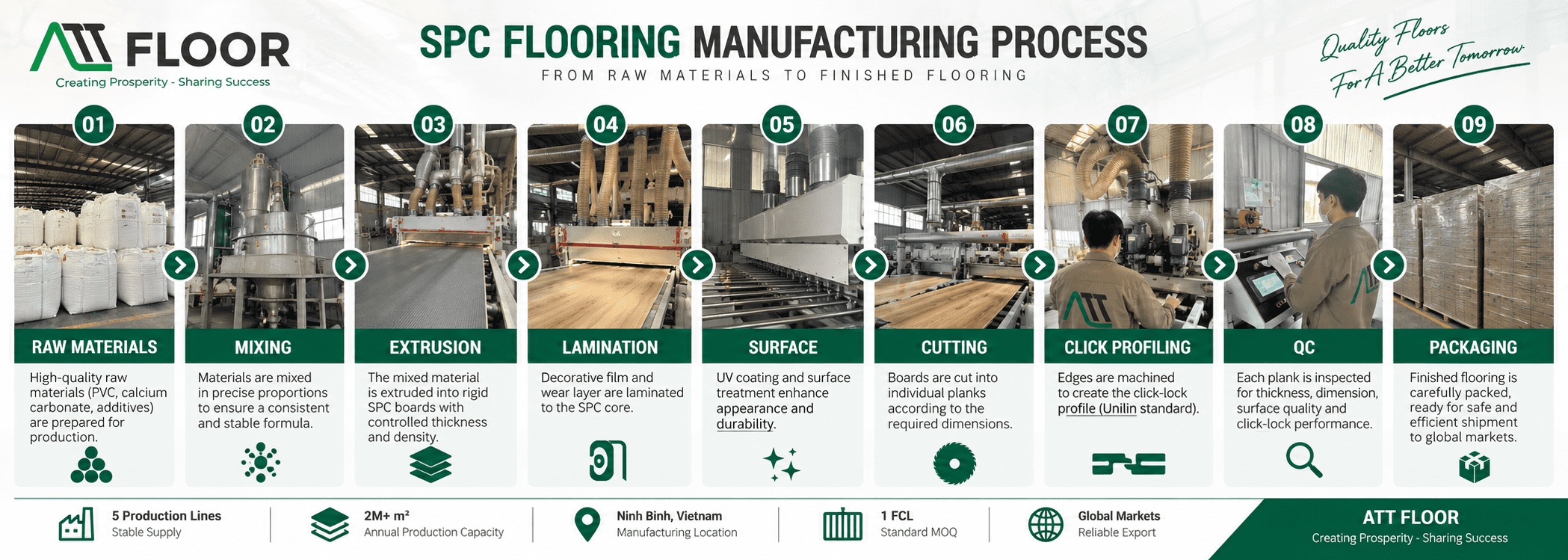
What Happens Inside an SPC Flooring Factory?
2. Stage One: Raw Material Preparation and Mixing
Every finished SPC plank begins with its raw-material formulation.
2.1. Main Components of the SPC Core
The rigid core is produced from a formulation based primarily on materials such as:
- Calcium carbonate
- PVC resin
- Stabilizers
- Processing aids
- Other additives required by the formulation
The exact formulation and manufacturing parameters can vary between products and manufacturers.
From a buyer's perspective, however, the important issue is consistency.
The same product specification should not behave differently simply because the production batch changes.
2.2. Why Mixing Consistency Matters
Before extrusion, the materials need to be prepared and mixed according to the required formulation.
Uniform mixing helps create a more consistent material before it enters the next production stage.
This may not be the most visually impressive part of an SPC factory.
But it is an important reminder:
Finished flooring quality begins before the flooring even looks like a plank.
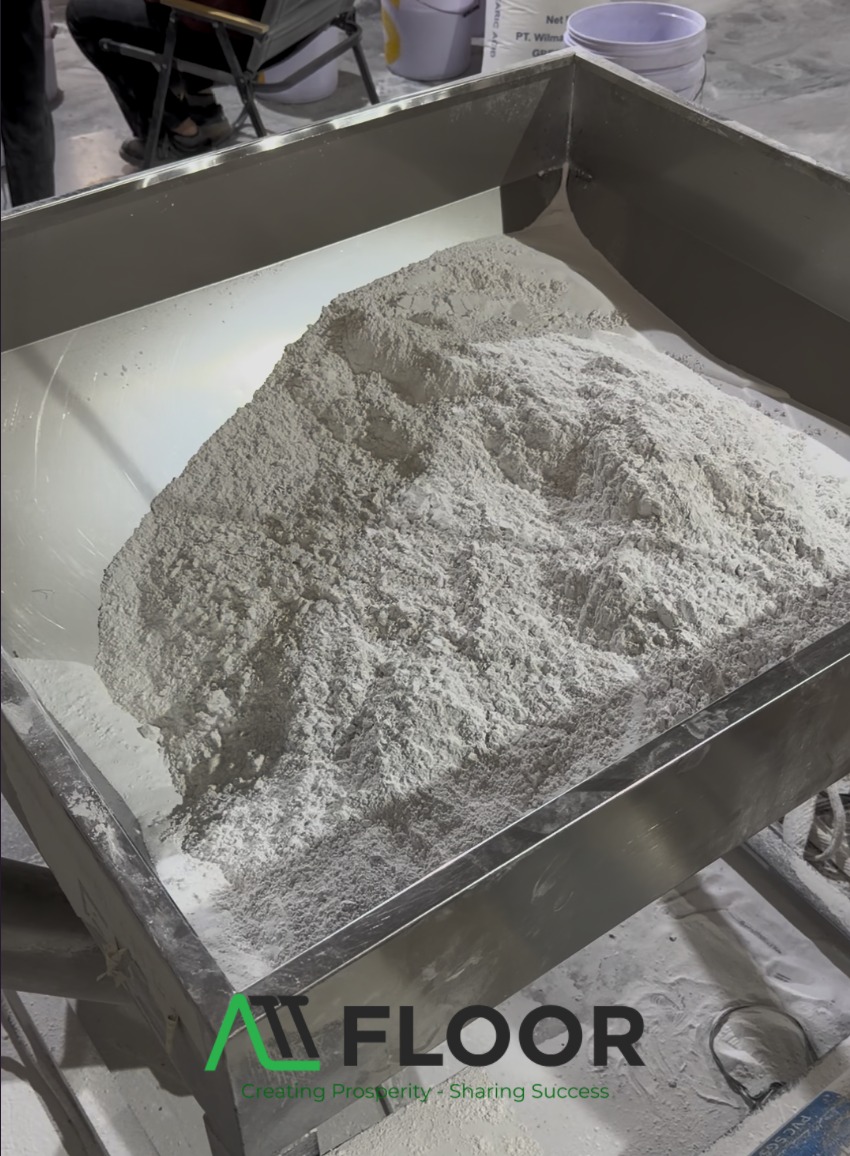
Why Mixing Consistency Matters
3. Stage Two: SPC Core Extrusion
Extrusion is one of the fundamental stages of SPC flooring production.
The prepared material enters the extrusion system, where heat and mechanical processing transform the formulation into a continuous rigid SPC board.
3.1. Forming the Rigid Core
During extrusion, manufacturing parameters need to remain controlled so that the board is produced according to the intended specification.
Important factors can include:
- Material formulation
- Temperature
- Processing speed
- Board thickness
- Density
- Dimensional consistency
The objective is not simply to create a hard board.
It is to create a stable and repeatable core suitable for the following manufacturing stages.
3.2. Why Core Consistency Matters to Buyers
The rigid core forms the structural foundation of SPC flooring.
Variation at this stage can influence characteristics later in the process, including:
- Dimensional consistency
- Finished thickness
- Profiling accuracy
- Installation performance
For importers buying container quantities, consistency across thousands of planks matters much more than the appearance of one selected sample.
Why Core Consistency Matters to Buyers
4. Stage Three: Decorative Film and Wear Layer Lamination
Once the structural board is formed, the product begins to acquire the appearance and surface construction customers recognize as flooring.
4.1. Decorative Film
The decorative film creates the visible design of the flooring.
This is where an SPC plank can take on the appearance of:
- Oak
- Walnut
- Natural wood
- Grey wood
- Stone
- Other decorative patterns
For flooring distributors, this stage has strong commercial importance.
A product can have excellent technical specifications, but the design still needs to sell in the target market.
4.2. Wear Layer
Above the decorative layer is the wear layer, which helps protect the visible surface during use.
Different markets and applications may require different wear-layer specifications.
However, wear layer deserves its own detailed discussion.
How to Choose the Right Wear Layer for SPC Flooring?
4.3. Lamination Control
During this stage, the different layers need to become a consistent flooring structure.
The process must be controlled so that the appearance and construction remain stable throughout production.
For the buyer, the important result is straightforward:
The finished flooring should match the approved design and specification consistently across the order.
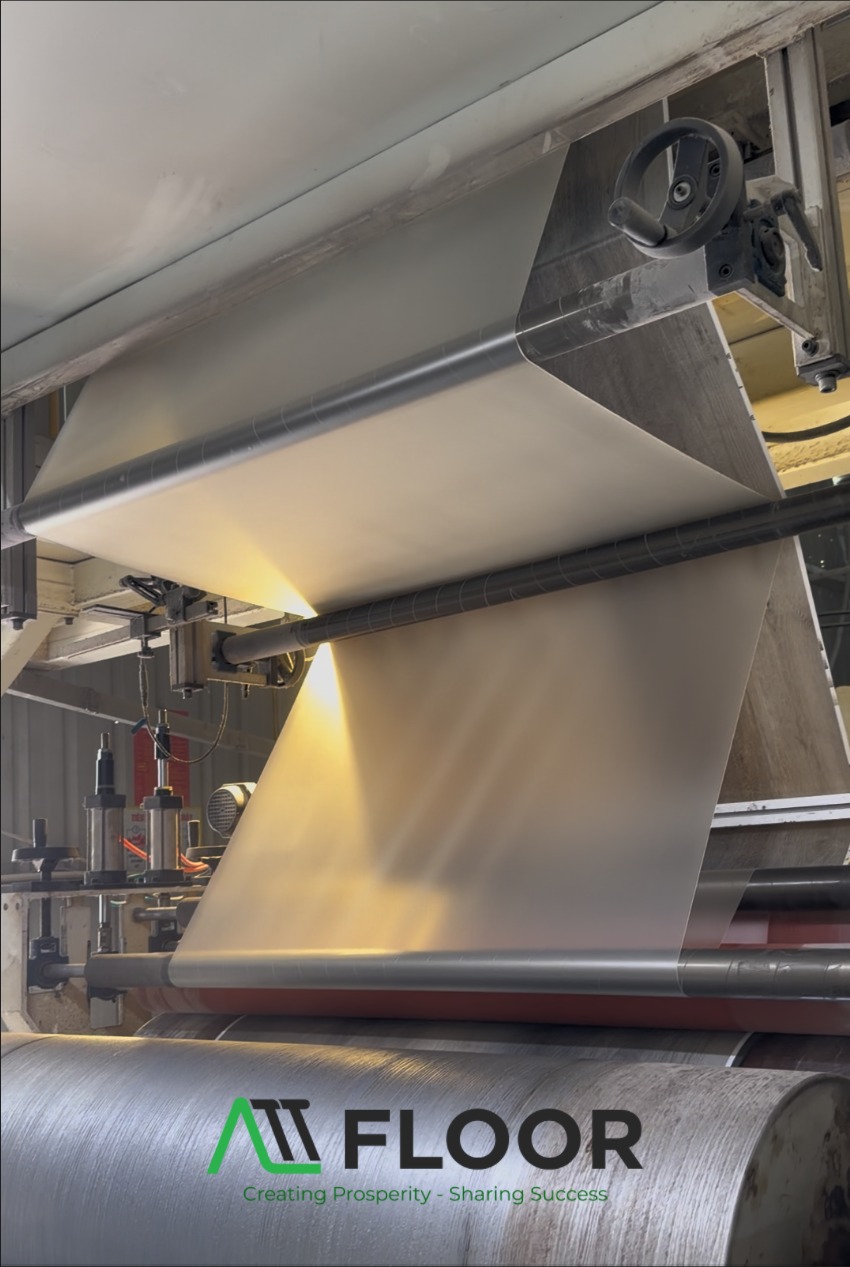
Lamination Control
5. Stage Four: UV Coating and Surface Treatment
The surface of an SPC floor affects both its appearance and how the customer experiences the product.
5.1. UV Surface Treatment
A UV coating is applied as part of the surface-finishing process.
Its role is to help protect the flooring surface and contribute to the finished appearance of the product.
But from a product-development perspective, surface treatment is not only about protection.
It also affects how the flooring looks and feels.
5.2. Surface Appearance Matters
Depending on the product design, buyers may consider different surface characteristics such as:
- Matte appearance
- Wood-texture embossing
- Surface texture
- Gloss level
- EIR or other embossing options where applicable
The right choice depends on the product's intended market position.
A flooring collection designed for an entry-level residential market may have different priorities from a collection positioned as a more premium product.
Technical specification and visual positioning need to work together.
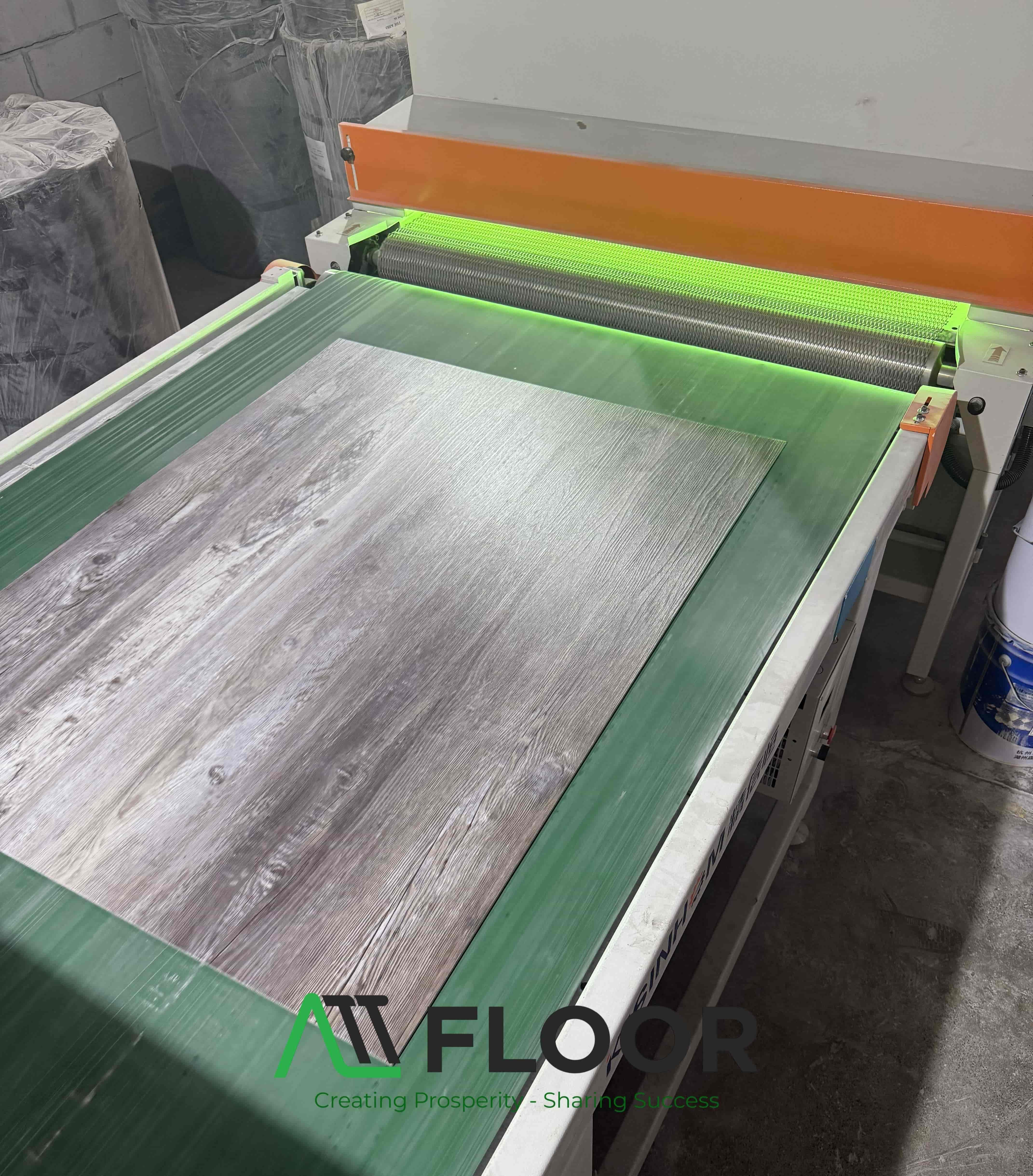
Surface Appearance Matters
6. Stage Five: Cutting and Click-Lock Profiling
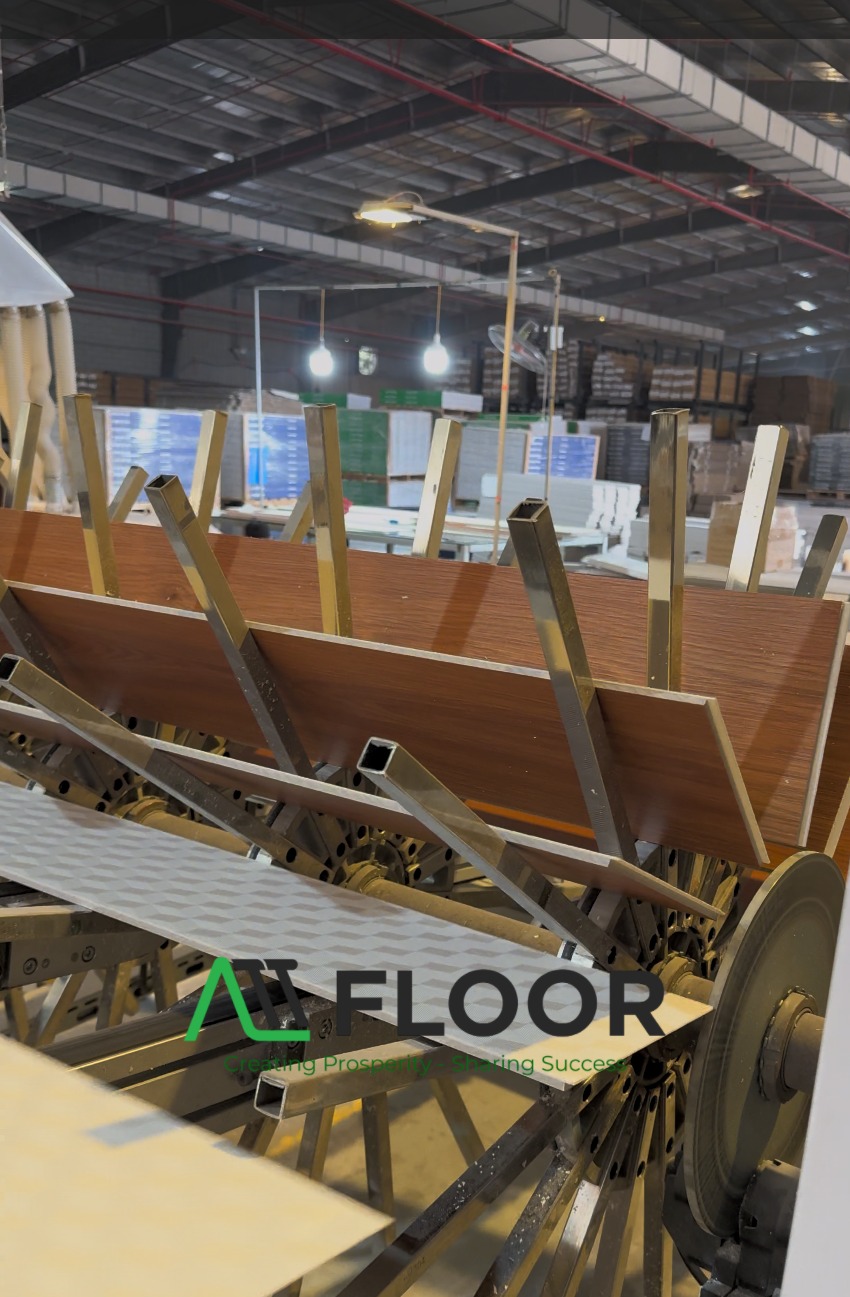
At this stage, large boards are transformed into individual flooring planks and their edges are machined to create the locking profile.
This is one of the stages where precision becomes particularly visible to the end user.
6.1. Cutting the Flooring Into Planks
The boards need to be cut according to the required product dimensions.
Consistency matters because flooring installation depends on large numbers of individual planks working together as one system.
Small dimensional deviations repeated across a floor can become much more noticeable than they appear on a single plank.
6.2. Creating the Click-Lock Profile
The edges are then machined to create the click-lock profile.
A properly machined locking system helps the planks connect accurately during installation.
This is why profiling should not be viewed as merely cutting the edge of the board.
It is a precision manufacturing stage.
At ATT Floor, click-lock flooring is produced under applicable Unilin licensing requirements.
6.3. Why Profiling Accuracy Matters
Poor profiling can potentially contribute to issues such as:
- Difficult installation
- Uneven joints
- Visible gaps
- Poor locking
- Inconsistent plank connections
For buyers, one simple way to evaluate this area is to physically assemble samples and inspect how the joints fit together.
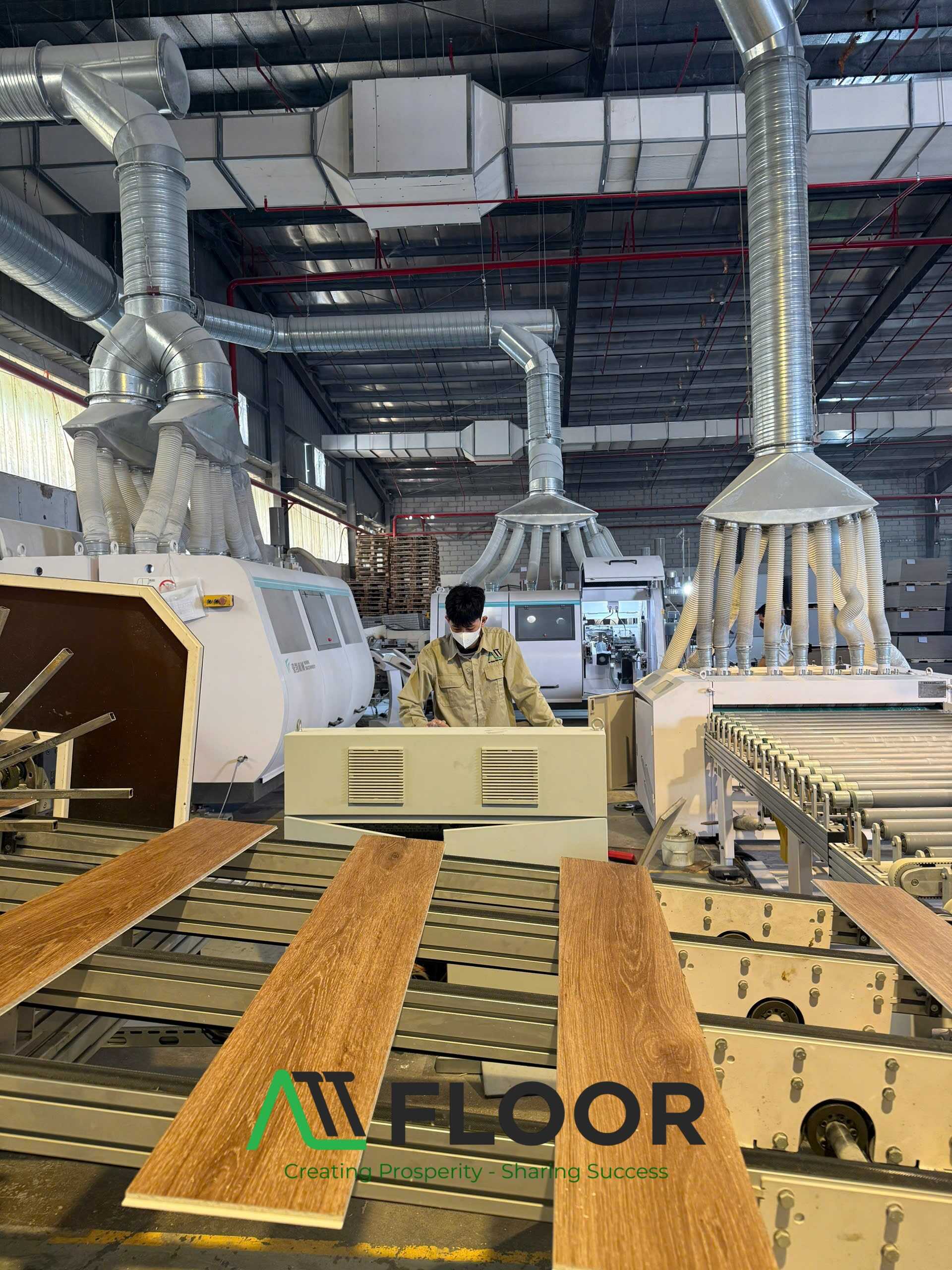
Why Profiling Accuracy Matters
7. Stage Six: Underlayment Application
Many SPC flooring products are supplied with an attached underlayment.
Depending on the product specification, this may include materials such as IXPE or other suitable backing options.
7.1. Why Attached Underlayment Is Used
An attached pad can contribute to characteristics such as:
- Underfoot comfort
- Sound reduction
- Installation convenience
- Product positioning
However, thicker does not automatically mean better.
The correct configuration depends on the overall flooring construction and target application.
7.2. Matching the Pad to the Product
For importers, underlayment should be considered as part of the complete product specification, rather than an isolated feature.
Core thickness, pad thickness, target price, application, and market expectations should be considered together.
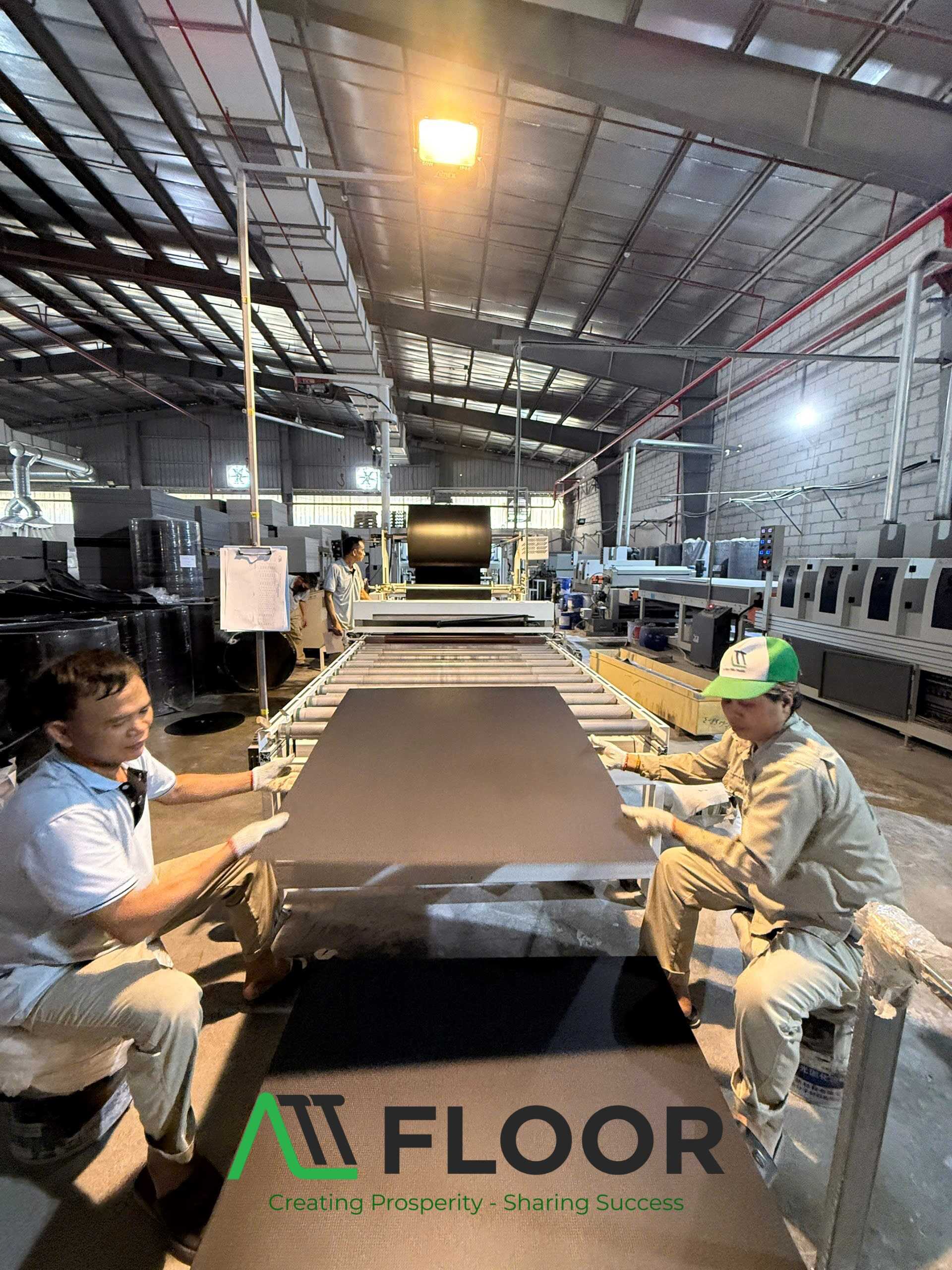
Matching the Pad to the Product
8. Stage Seven: Quality Control
Quality control should not exist only at the end of production.
The more useful approach is to monitor relevant characteristics throughout manufacturing and inspect the finished product before packaging and shipment.
8.1. Dimensional and Thickness Checks
Finished flooring should be checked against the agreed product specification.
At ATT Floor, this can include checking characteristics such as product thickness and dimensions during the QC process.
8.2. Surface Inspection
The flooring surface can be inspected for visible issues involving:
- Decorative appearance
- Surface condition
- Edge condition
- Overall finish
8.3. Click-Lock Assembly Check
Individual planks can also be assembled to evaluate the fit between boards.
This is particularly useful because a locking profile may look acceptable when inspected individually but reveal an issue when multiple planks are connected.
8.4. Product Testing
Depending on the product and requirements, different tests can be used to evaluate relevant characteristics.
ATT Floor regularly documents factory QC activities such as:
- Thickness inspection
- Assembly checks
- Abrasion testing
- Scratch testing
- Water-resistance demonstrations
However, different tests evaluate different characteristics and should be interpreted according to the relevant testing method and product specification.
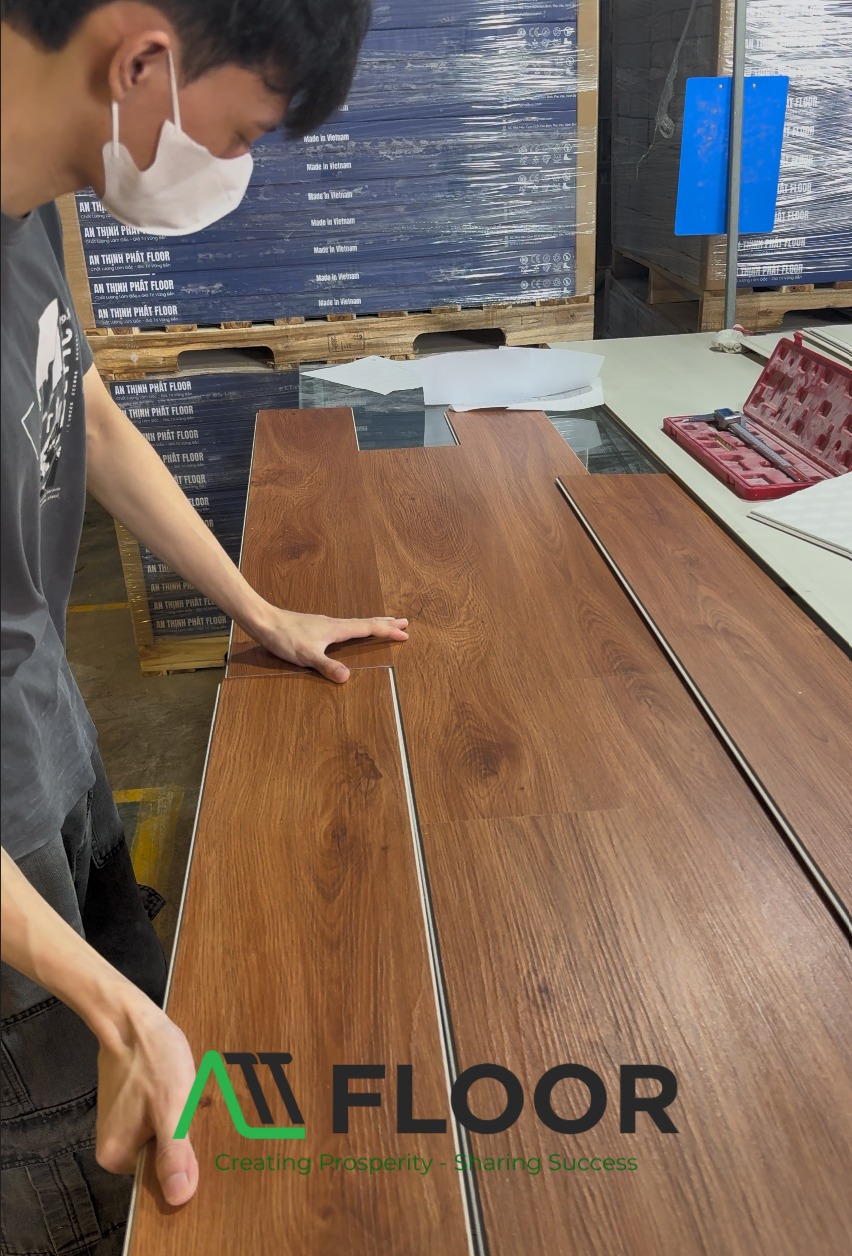
Product Testing
9. Stage Eight: Packaging and Final Order Check
Once production and inspection are complete, the flooring needs to be prepared for shipment.
Packaging may appear to be a simple final step.
For an importer, it is not.
9.1. Protecting the Product
Packaging needs to help protect the flooring during:
Factory handling → Warehousing → Container loading → Ocean transport → Destination handling
Damage after production still becomes a problem for the buyer, regardless of whether the flooring itself was manufactured correctly.
9.2. Product and Packaging Identification
Depending on the buyer's requirements, packaging may include:
- Product information
- Color/design identification
- Quantity information
- Buyer branding
- Shipping marks
- Private-label artwork
This becomes especially important when distributors carry multiple collections or specifications.
9.3. Final Check Before Shipment
Before loading, the supplier should confirm that the finished order corresponds with the agreed requirements.
This provides one final checkpoint before the product leaves the factory.
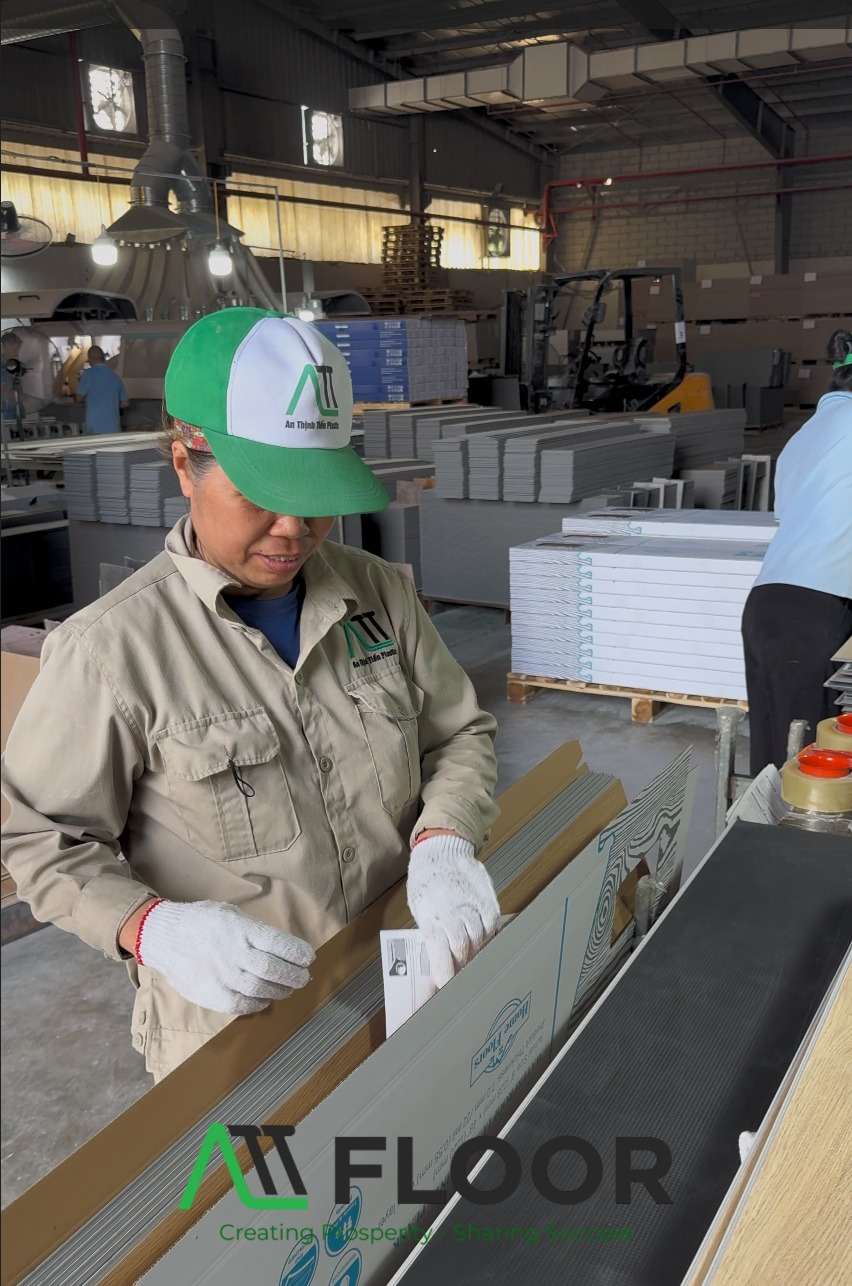
Final Check Before Shipment
10. Stage Nine: Container Loading and Export
The manufacturing process may technically be finished once the flooring is packaged.
For the buyer, however, the order is not finished until the goods are prepared correctly for shipment.
10.1. Preparing the Container
Before loading, the container and loading conditions should be checked as appropriate for the shipment.
Products then need to be loaded according to the planned quantity and packaging configuration.
10.2. From Factory Floor to International Market
This is the point where all previous stages come together.
The product has moved through:
Materials → Production → Surface → Profiling → QC → Packaging
and is now ready to leave the SPC Flooring Factory in Vietnam for its destination market.
For an importer, this is why manufacturing should be viewed as a complete system rather than a collection of individual machines.
Every stage contributes to the product that eventually reaches the customer.
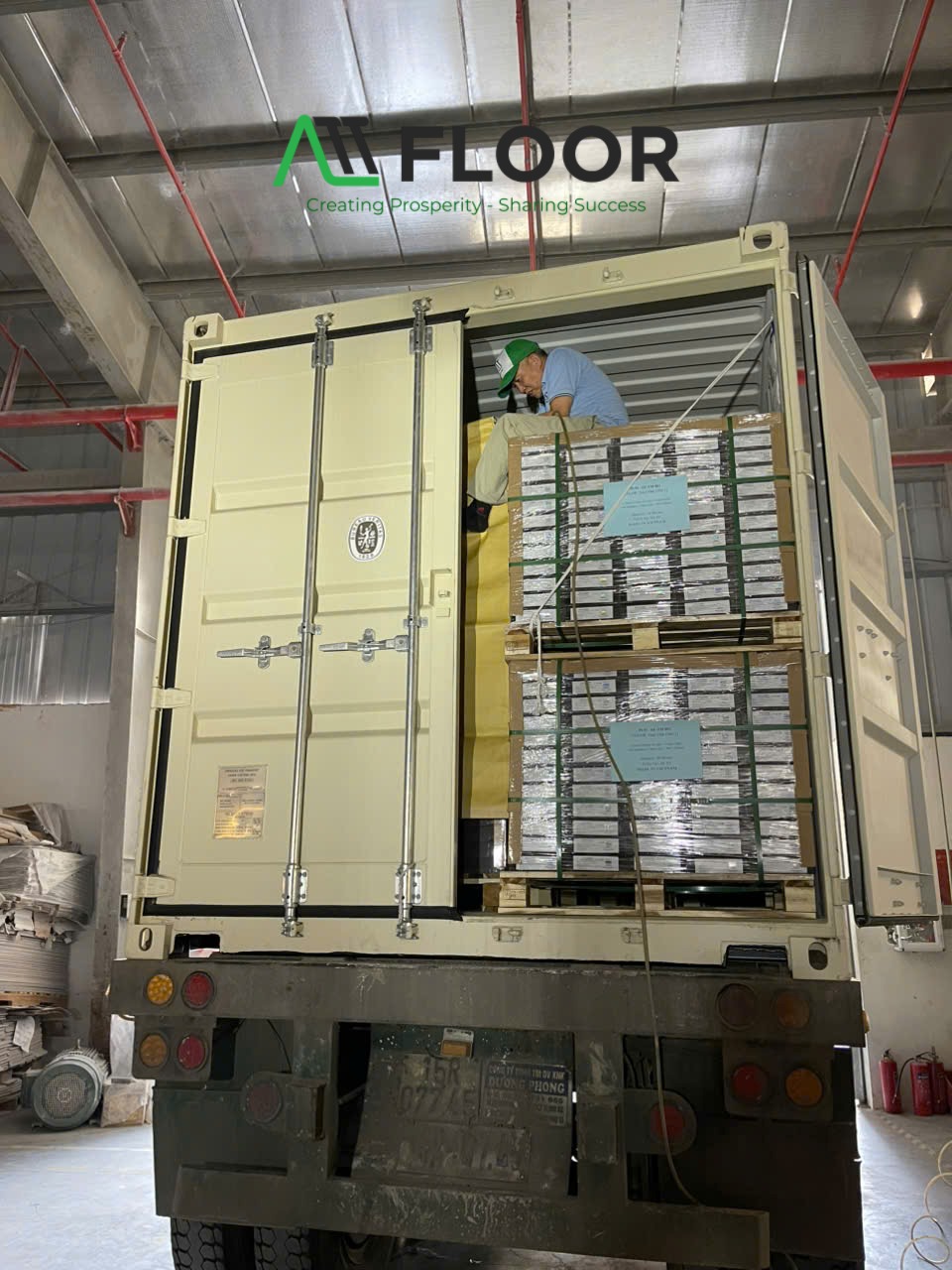
From Factory Floor to International Market
11. How ATT Floor Approaches SPC Flooring Manufacturing
ATT Floor's manufacturing operation is based in Ninh Binh, Vietnam.
Our current production capability includes:
| Factory Information | ATT Floor |
|---|---|
| Manufacturing Location | Ninh Binh, Vietnam |
| Production Lines | 5 |
| Annual Capacity | Up to 2 million m² |
| Main Product | SPC Rigid Core Flooring |
| Supply Model | Factory Direct |
| Standard MOQ | Generally 1 Full Container |
| OEM / Private Label | Available |
But factory capability should not be evaluated only by numbers.
For international buyers, the more important question is whether the manufacturing system can deliver the agreed product consistently across repeat orders.
That is the standard we aim to build around.
12. What Should Buyers Look at During a Factory Evaluation?
Whether evaluating ATT Floor or another factory, buyers can use a simple framework.
12.1. Production
Look at:
- Production equipment
- Manufacturing stages
- Factory organization
- Production capability
- Actual products being manufactured
12.2. Product
Check:
- Finished thickness
- Dimensions
- Surface
- Decorative design
- Edge/profile
- Underlayment
- Assembly
12.3. Quality Control
Ask:
- What is checked?
- At which production stage?
- How are results recorded?
- What happens when a deviation is identified?
12.4. Packaging and Export
Review:
- Carton quality
- Product identification
- Pallet/loading method
- Export preparation
12.5. Consistency
And finally, ask one of the most important questions:
Can the factory reproduce the approved specification consistently when I reorder?
For a distributor, that question may matter more than how impressive the factory looks during a visit.
13. Factory Transparency Builds Buyer Confidence
International buyers are often thousands of kilometers away from the factory producing their products.
That creates an information gap.
One way to reduce that gap is factory transparency.
Real photographs and videos of:
- Production
- Machinery
- Workers
- QC
- Testing
- Packaging
- Loading
give buyers more evidence to evaluate than a product catalog alone.
This is also why ATT Floor regularly documents our actual factory activities.
We believe international buyers should be able to see how the flooring they purchase is being made.
14. Looking for an SPC Flooring Factory in Vietnam?
If you are evaluating an SPC Flooring Factory in Vietnam, the best starting point is not simply asking:
“What is your lowest price?”
Start with the product instead.
Send ATT Floor:
14.1. Your Target Specification
For example:
- Overall thickness
- Wear layer
- Underlayment
- Plank dimensions
- Surface requirements
14.2. Estimated Quantity
Let us know your approximate order volume or container requirement.
14.3. Destination Market
Tell us where the product will be imported and sold.
From there, we can discuss a suitable configuration and prepare a factory-direct quotation based on your requirements.
See the Product. Understand the Process. Evaluate the Factory.
Contact ATT Floor to discuss your SPC flooring requirements, request samples, or learn more about our manufacturing operation in Vietnam.
15. Frequently Asked Questions
15.1. Where is ATT Floor's SPC flooring factory?
ATT Floor's manufacturing facility is located in Ninh Binh, Vietnam.
15.2. How many production lines does ATT Floor operate?
ATT Floor currently operates five production lines for its manufacturing operation.
15.3. What is ATT Floor's annual production capacity?
Our annual production capacity is up to 2 million square meters.
15.4. Does ATT Floor manufacture SPC flooring directly?
Yes. ATT Floor manufactures SPC rigid core flooring at our factory in Vietnam and supplies international importers, distributors, wholesalers, and flooring brands.
15.5. Can buyers request different SPC specifications?
Yes. Product configurations can be discussed according to the buyer's market and requirements, including thickness, wear layer, underlayment, dimensions, designs, surface options, and packaging.
15.6. Does ATT Floor support OEM and private label?
Yes. OEM and private-label solutions can be discussed according to the project requirements.
15.7. Can buyers request samples before placing a container order?
Yes. Buyers can discuss sample requirements before moving forward with a full-container order.
16. About ATT Floor
ATT Floor operates an SPC Flooring Factory in Vietnam, based in Ninh Binh and focused on factory-direct supply for international buyers.
Production Lines: 5
Annual Capacity: Up to 2 Million m²
Manufacturing Location: Ninh Binh, Vietnam
Product Focus: SPC Flooring | Rigid Core Flooring
Standard MOQ: Generally 1 Full Container
Business Model: Factory Direct | OEM | Private Label | International Export
-------------------------------------------------------------------------------------------------------------------
You can refer to SPC Flooring Supplier in Vietnam: What Importers Should Look for Beyond Price
Manufacturing Factory 1: Km7, Ha Nam Ward, Ninh Binh Province, Vietnam
Manufacturing Factory 2: Kim Binh Cluster, Ha Nam Ward, Ninh Binh Province, Vietnam
Manufacturing Factory 3: Lot CN-1.7, Le Ho Industrial Cluster, Le Ho Ward, Ninh Binh
Phone/WsA: +84 915961582
Email: tom@attfloors.com

SPC Flooring Factory in Vietnam: Inside the Manufacturing Process
Thursday,
03/09/2026


SPC Flooring Manufacturer in Vietnam: What International Buyers Should Know
Thursday,
20/08/2026

Why Importers Are Switching from Laminate to SPC Flooring?
Monday,
17/08/2026
