 +84855336622
 sales.attfloor@gmail.com


-
-
-
Total payment amount:
-


SPC Flooring Container Loading Guide: How Specifications Affect Quantity, Weight and Landed Cost
Monday,
05/10/2026
0
For an SPC flooring importer, one container is not simply a shipping unit.
It is also a cost unit.
Two SPC flooring products may have similar FOB prices, but if their thickness, weight, packaging or loading configuration is different, the final cost per square foot can also be different.
That is why professional buyers should ask more than:
“What is your price per square foot?”
They should also ask:
“How many square feet can we actually load into one container?”
This guide explains how SPC flooring specifications, product weight, packaging and container limits work together—and why container loading should be considered before an order is finalized.
1. Why Container Loading Matters for SPC Flooring
SPC flooring is a relatively dense product.
Unlike lightweight goods where container volume may be the primary limitation, flooring shipments can reach weight limitations before all available container space is used.
This creates a direct relationship:
Product Specification
↓
Product Weight
↓
Loading Quantity
↓
Ocean Freight per Sq Ft
↓
Landed Cost
A small change in specification can therefore influence much more than the factory price.
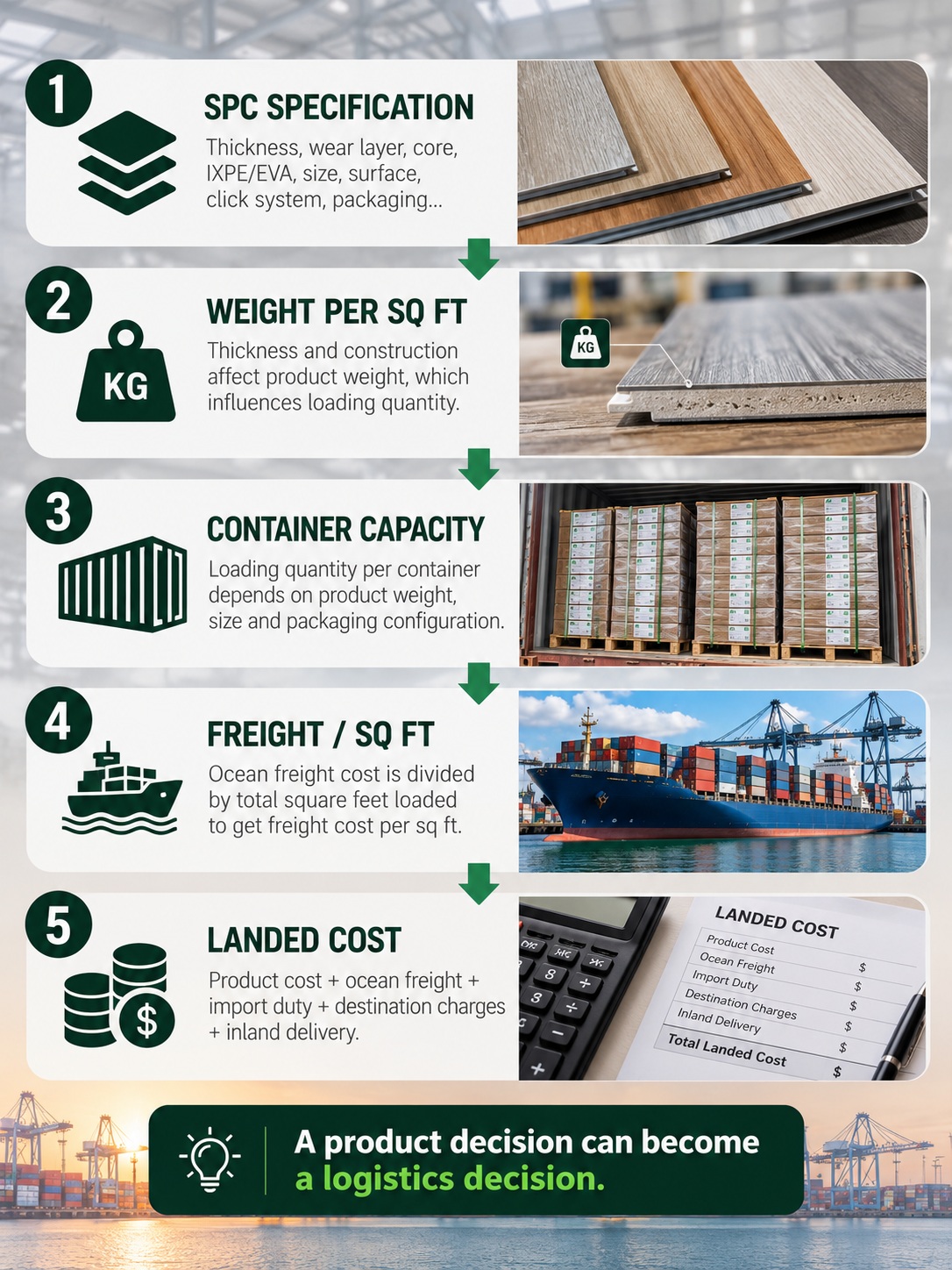
SPC flooring container loading and landed cost
2. Weight vs Volume: Which One Limits an SPC Container?
Every container has both physical space and weight limitations.
For SPC flooring, weight is often particularly important because of the density of the rigid core.
2.1. Why SPC Flooring Is Heavy
The SPC core contains a substantial mineral component combined with PVC and other materials.
As the core becomes thicker, more material is required per square foot.
Therefore:
Higher thickness → More material → More weight per sq ft
This does not mean thicker flooring is bad.
It simply means the buyer should understand the logistics consequence of the specification.
2.2. Container Capacity Is Not One Universal Number
Buyers sometimes ask:
“How many square feet fit in a 20FT container?”
There is no single answer.
It depends on:
- Core thickness
- Overall construction
- Plank dimensions
- Attached underlayment
- Packaging
- Pieces per carton
- Cartons per pallet
- Number of pallets
- Product weight
- Shipping and destination restrictions
For this reason, loading quantity should always be calculated from the final confirmed specification.
3. How Thickness Changes Container Loading
Consider two products with the same plank dimensions and similar packaging.
Product A: thinner SPC core
Product B: thicker SPC core
Product B uses more core material per square foot.
Its weight per square foot will therefore normally be higher.
If the shipment is approaching its allowable weight, fewer square feet of Product B may be loaded into the same container.
This is where buyers need to distinguish between:
Price per Sq Ft
and
Cost per Imported Sq Ft
The two are related—but they are not the same thing.
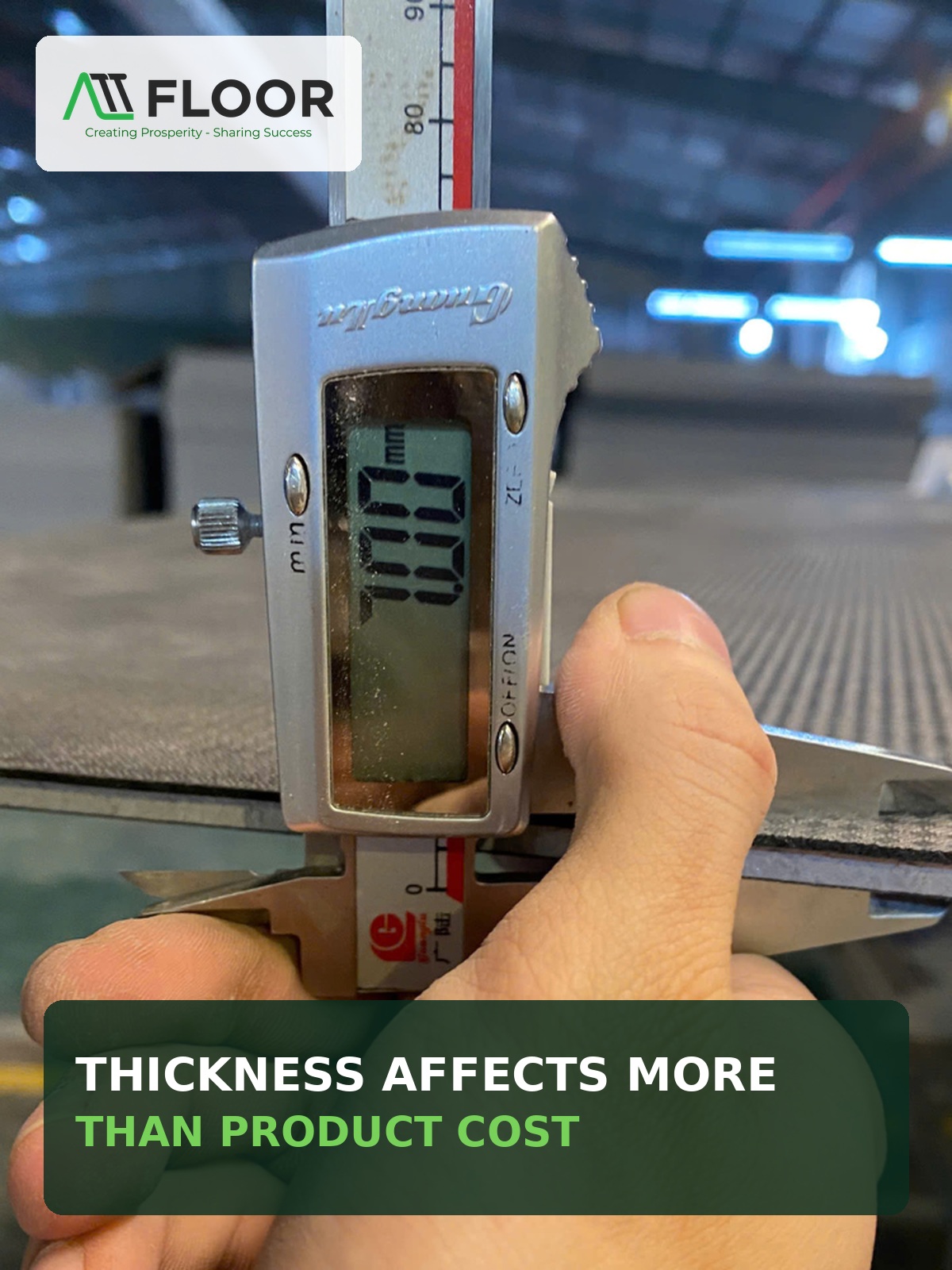
SPC flooring thickness and container weight
4. Packaging Also Affects Loading Efficiency
Product thickness is only part of the calculation.
Packaging configuration also matters.
A typical loading plan needs to consider:
Planks per Carton → Cartons per Pallet → Pallets per Container
Changes at any of these levels can affect the final loading quantity.
4.1. Carton Configuration
The manufacturer needs to determine how many planks can be packed safely and practically into each carton.
A carton should not simply maximize quantity.
It also needs to remain manageable for:
- Factory handling
- Warehouse operations
- Distribution
- Installation
- Product protection
4.2. Pallet Configuration
Cartons are then arranged on pallets.
Pallet dimensions, stacking height and total pallet weight all influence container planning.
Good loading is therefore a balance between:
Efficiency + Protection + Practical Handling
not simply squeezing the maximum possible number of cartons into the container.
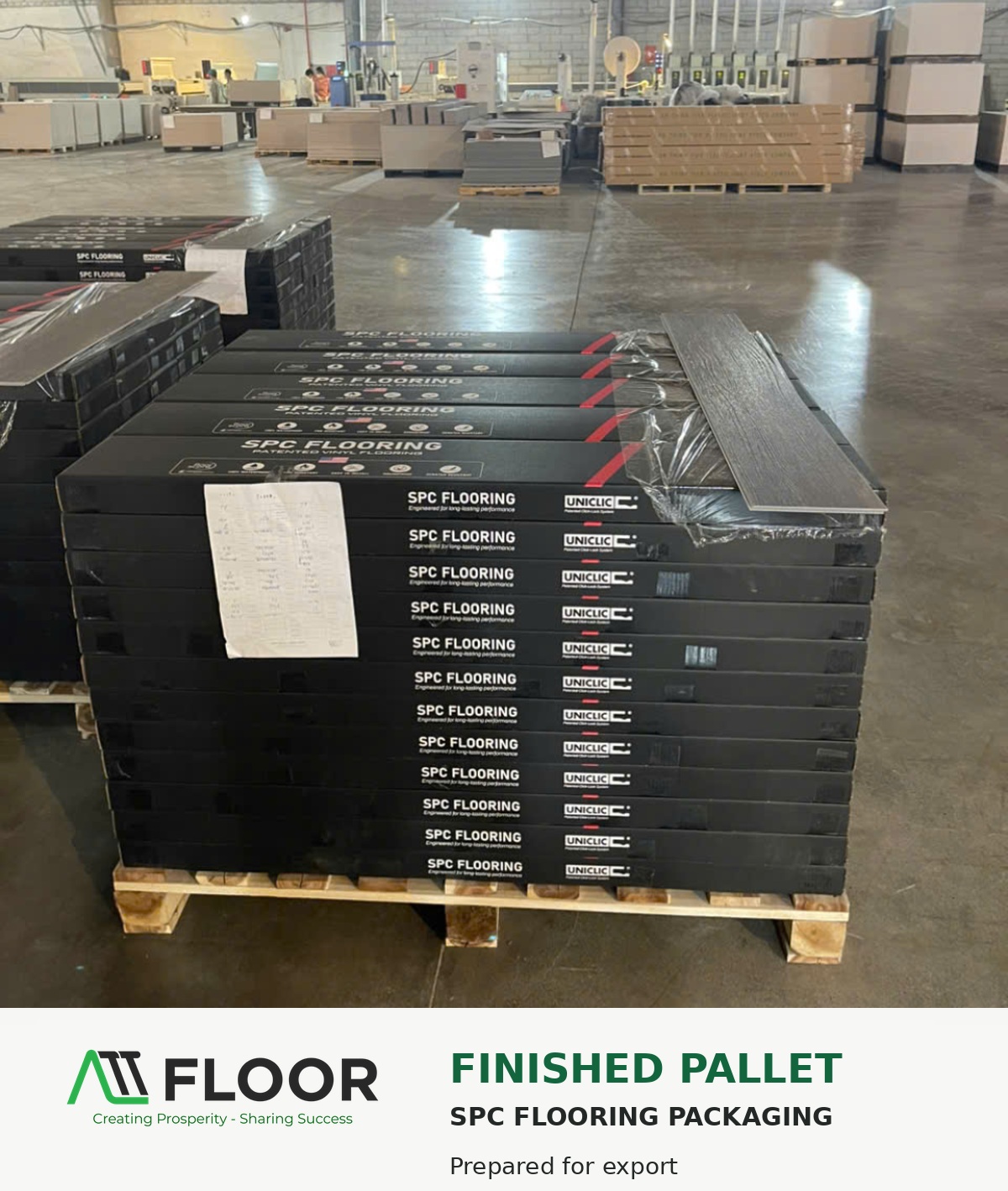
SPC flooring pallet packaging for export
5. Why 20FT Containers Are Common for SPC Flooring
Because SPC flooring is dense, a 20-foot container can be commercially practical for many flooring shipments.
The important consideration is not simply the physical size of the container.
It is the relationship between:
Cargo Weight + Loading Configuration + Destination Rules
A larger container does not automatically mean the buyer can proportionally load more SPC flooring.
If cargo weight becomes the limiting factor first, additional cubic space provides little benefit.
That is why container selection should be based on the actual product and route, not only on container dimensions.
6. Gross Weight Is Not the Only Weight to Consider
This is an area where importers should be careful.
A container shipment involves several weight concepts.
Net Product Weight
The weight of the flooring itself.
Packaging Weight
Cartons, pallets, straps and other packaging materials add additional weight.
Cargo Gross Weight
Product plus packaging.
Container Gross Weight
Cargo plus the container itself.
The operational limit may also depend on the carrier, port, inland transportation and destination regulations.
Therefore, a factory's theoretical maximum loading calculation should not automatically be treated as the permitted weight for every shipment.
Always confirm the actual route before finalizing the loading plan.
That one step can prevent expensive logistics problems later.
7. Container Quantity Changes Freight Cost per Sq Ft
This is where loading efficiency becomes commercially important.
Imagine ocean freight for one container is:
$6,000
If Container A carries:
40,000 sq ft
the ocean freight allocation is:
$0.150/sq ft
If another configuration allows only:
35,000 sq ft
the same $6,000 becomes approximately:
$0.171/sq ft
That difference is around:
$0.021/sq ft
At first glance, two cents may not sound significant.
But across tens or hundreds of thousands of square feet, the effect becomes meaningful.
And ocean freight is only one component of landed cost.
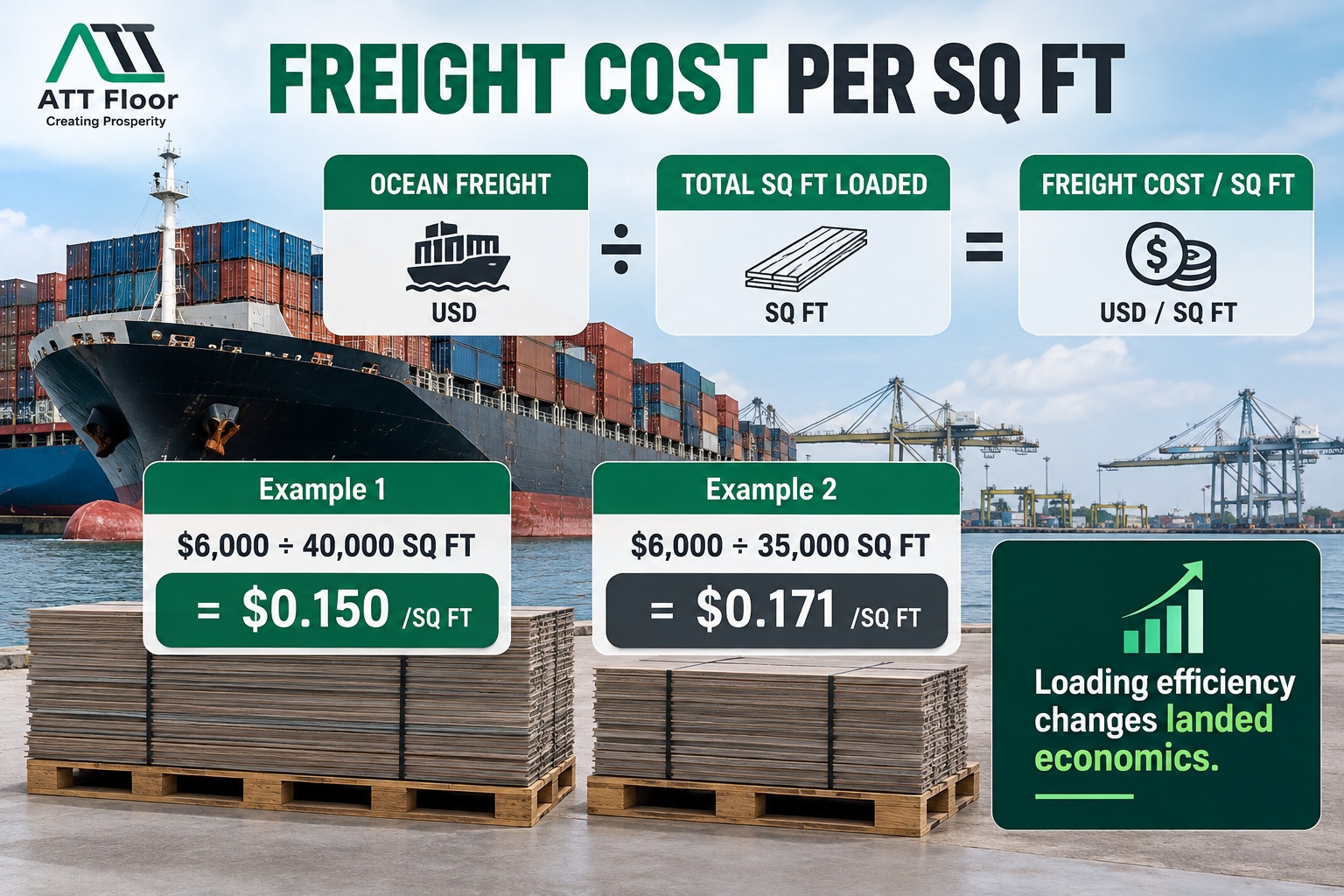
SPC flooring freight cost per square foot
8. Do Not Optimize Loading at the Expense of Product Quality
There is an important limit to this logic.
Buyers should not reduce product specifications simply to maximize container quantity.
The objective is not:
Load as many square feet as possible.
The objective is:
Develop the right product for the market and then optimize the logistics around that product.
If a market genuinely requires a thicker construction or a particular performance level, that specification should remain the priority.
Container economics should help buyers understand the commercial consequences—not dictate every product decision.
This distinction matters.
9. Why FOB Price Alone Can Be Misleading
Consider two suppliers.
Supplier A
FOB: $0.55/sq ft
Supplier B
FOB: $0.57/sq ft
At first glance, Supplier A wins.
But suppose differences in construction, packaging or loading quantity cause Supplier A's freight allocation and other costs per square foot to be higher.
The final difference may become much smaller—or potentially reverse.
This is why experienced importers increasingly evaluate:
Landed economics rather than factory price alone.
A quotation becomes much more useful when the buyer understands both:
FOB Price + Loading Quantity
rather than FOB price in isolation.
How to Import SPC Flooring from Vietnam: A Practical Guide for International Buyers
10. What Buyers Should Ask Before Confirming an Order
Before confirming an SPC flooring container, request a complete loading calculation.
At minimum, confirm:
| Item | Confirm Before Order |
|---|---|
| Plank Size | Length × Width |
| Product Construction | Core + Pad |
| Planks / Carton | Confirmed |
| Sq Ft / Carton | Confirmed |
| Cartons / Pallet | Confirmed |
| Pallets / Container | Confirmed |
| Total Sq Ft | Estimated loading |
| Cargo Weight | Estimated |
| Container Type | 20FT / other |
| Destination | Port / inland destination |
This makes quotation comparison much more meaningful.
Instead of comparing:
Supplier A: $X/sq ft
Supplier B: $Y/sq ft
you can compare:
Product + Price + Container Quantity + Estimated Landed Economics
That is a much stronger purchasing decision.
11. How ATT Floor Plans SPC Flooring Container Loading
At ATT Floor, container planning begins with the confirmed product specification.
Once thickness, wear layer, underlayment, plank size and packaging are defined, we can calculate the appropriate packing and loading configuration.
For international orders, buyers can request information such as:
- Planks per carton
- Square feet per carton
- Cartons per pallet
- Pallets per container
- Estimated total square feet
- Estimated cargo weight
This helps the buyer evaluate the order not only as a product purchase, but as an import transaction.
ATT Floor's standard MOQ is generally one full container, making loading efficiency particularly relevant for our international customers.
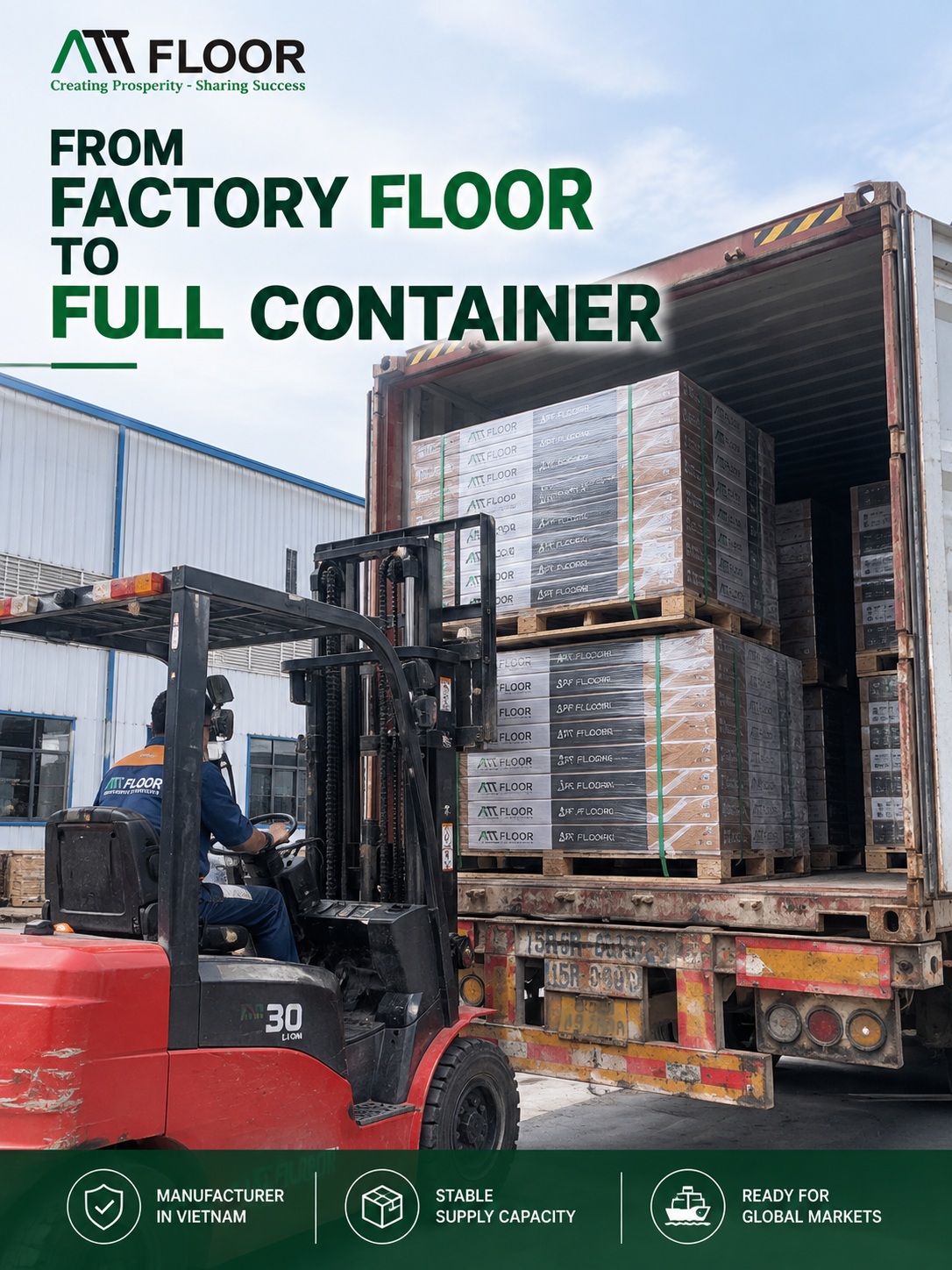
ATT Floor SPC flooring container loading Vietnam
12. Specification and Logistics Should Be Decided Together
A flooring product does not stop at the factory gate.
It still needs to be:
Packed → Loaded → Shipped → Cleared → Delivered → Sold
For that reason, specification development and logistics should not happen independently.
A better sequence is:
Target Market
↓
Product Specification
↓
Factory Price
↓
Loading Quantity
↓
Freight & Import Costs
↓
Landed Cost
↓
Target Selling Price
This creates a more complete view of the product's commercial viability.
The best specification is not simply the one that looks strongest on a technical sheet.
It is the one that meets the market requirement while creating a workable business model from factory to final customer.
13. Request a Container Loading Calculation From ATT Floor
If you are evaluating SPC flooring from Vietnam, send us:
Thickness / Wear Layer / IXPE / Plank Size / Quantity / Destination
ATT Floor can prepare a factory-direct quotation together with the relevant loading information for the proposed specification.
This allows you to evaluate more than:
“How much does the flooring cost?”
You can begin answering the more useful question:
“What will this product actually cost me to import?”
Export Sales Executive: Tom Nguyen
14. Frequently Asked Questions
14.1. How much SPC flooring fits in a 20FT container?
There is no universal quantity. It depends on product thickness, dimensions, weight, packaging configuration and applicable shipping limits.
14.2. Does thicker SPC flooring reduce container quantity?
A thicker SPC core generally uses more material and increases product weight per square foot. Where weight is the limiting factor, this can reduce the total flooring area loaded.
14.3. Why is SPC flooring often shipped in 20FT containers?
SPC flooring is relatively dense, so cargo weight can become an important constraint. The appropriate container should nevertheless be confirmed according to the product specification and shipping route.
14.4. Should I compare SPC suppliers by FOB price?
FOB price is important, but it should be compared together with equivalent specifications, loading quantity and expected landed cost.
14.5. Can ATT Floor calculate loading before I order?
Yes. Once the product specification and packaging configuration are confirmed, ATT Floor can provide an estimated loading plan for quotation and order planning.
15. Final Thought
When importing SPC flooring, the container should not be an afterthought.
It is part of the product economics.
A difference in thickness, weight or packaging can change loading quantity. Loading quantity changes freight cost per square foot. And freight cost influences the final landed cost.
So before choosing a product based only on FOB price, ask one more question:
How much of this product can I actually bring to market in each container?
That question connects product development, logistics and profitability—and helps importers make better purchasing decisions.
-------------------------------------------------------------------------------------------------------------------
You can refer to How to Choose SPC Flooring Specifications for Your Market
Manufacturing Factory 1: Km7, Ha Nam Ward, Ninh Binh Province, Vietnam
Manufacturing Factory 2: Kim Binh Cluster, Ha Nam Ward, Ninh Binh Province, Vietnam
Manufacturing Factory 3: Lot CN-1.7, Le Ho Industrial Cluster, Le Ho Ward, Ninh Binh
Phone/WsA: +84 915961582
Email: tom@attfloors.com


How to Choose SPC Flooring Specifications for Your Market
Friday,
18/09/2026


SPC Flooring Factory in Vietnam: Inside the Manufacturing Process
Thursday,
03/09/2026
