 +84855336622
 sales.attfloor@gmail.com


-
-
-
Total payment amount:
-


How to Choose SPC Flooring Specifications for Your Market
Friday,
18/09/2026
0
When sourcing SPC flooring, buyers often start with numbers:
5 mm or 6 mm? 12 mil or 20 mil? 1.0 mm or 1.5 mm IXPE?
These specifications matter—but they should not be the starting point.
A successful flooring program is not necessarily built around the highest specification. It is built around the right combination of performance, appearance, cost and market positioning.
For importers and distributors, the better question is therefore not:
“What is the best SPC flooring specification?”
It is:
“What specification is right for my market?”
This guide explains how to approach that decision.
1. Start With the Market
Before selecting thickness or wear layer, define who will buy the product.
1.1. Identify the Target Customer
Your customers may include:
- Flooring retailers
- Homeowners
- Contractors
- Builders
- Property managers
- Residential projects
- Commercial projects
Each segment has different expectations regarding price, durability, appearance and product positioning.
A price-sensitive rental program, for example, should not necessarily use the same specification as a higher-positioned retail collection.
1.2. Define Your Market Position
A simple framework is:
Entry-Level → Mainstream → Higher-Specification
Then ask:
What features does my customer actually value enough to pay for?
That question should guide the specification.
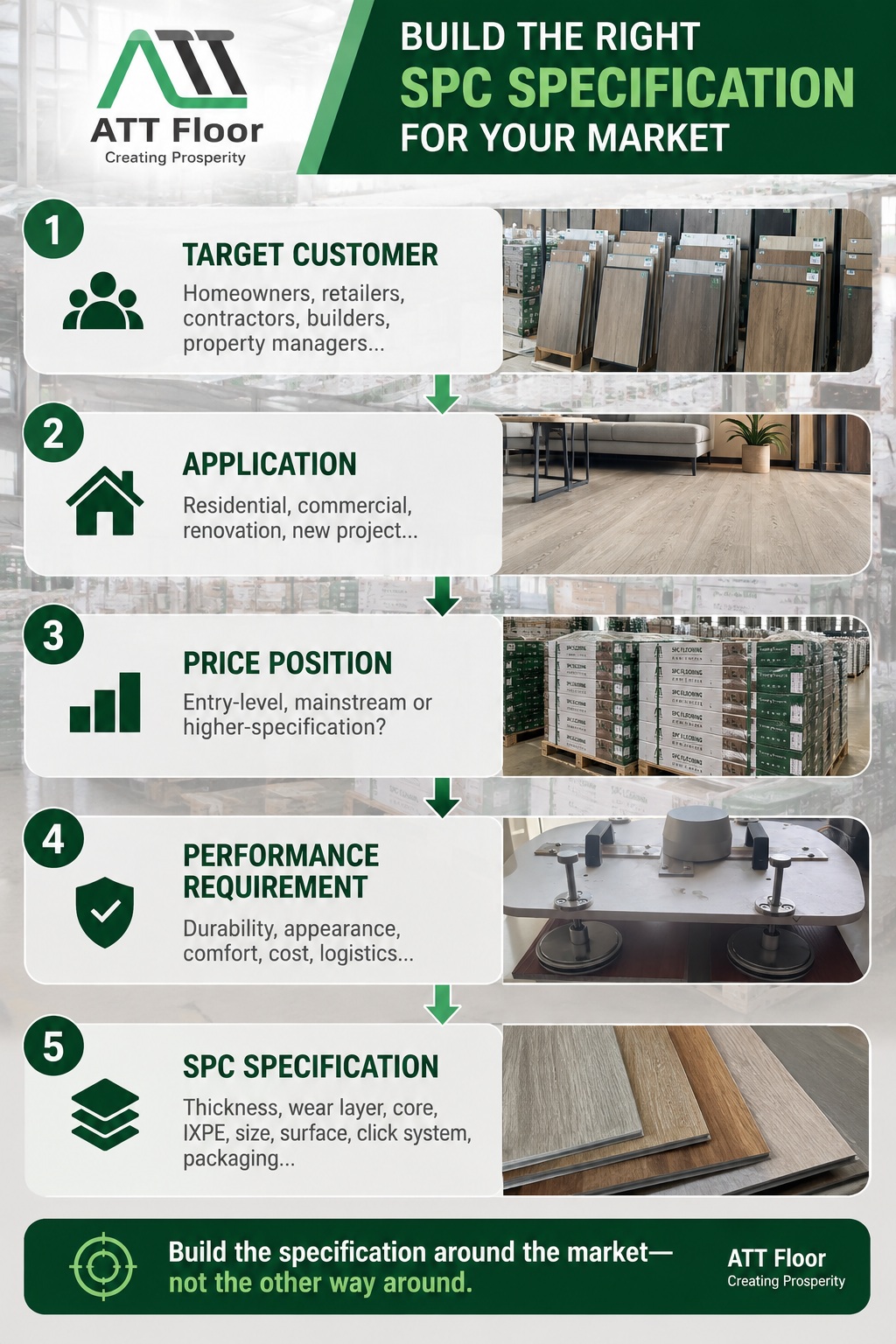
SPC flooring specification for different markets
2. Understand the SPC Flooring Structure
A typical SPC rigid core flooring product consists of several layers:
UV Coating
↓
Wear Layer
↓
Decor Film
↓
SPC Core
↓
Attached Underlayment
Each layer has a different purpose.
This is important because two products described simply as “5 mm SPC flooring” may have different constructions.
For example:
4.0 mm SPC Core + 1.0 mm IXPE = 5.0 mm Total Thickness
So when requesting quotations, buyers should specify the core and attached pad separately whenever possible.
That makes supplier quotations much easier to compare accurately.

SPC flooring layers and construction
3. How to Choose SPC Flooring Thickness
Thickness is one of the first specifications buyers compare.
However:
Thicker does not automatically mean better for every market.
Increasing core thickness generally means more material, which affects product cost and product weight.
The better approach is to consider thickness together with:
- Target customer
- Application
- Product positioning
- Required performance
- Target selling price
- Logistics
For a price-sensitive product line, adding thickness simply to create a larger number on the carton may reduce competitiveness.
For another market, a more substantial construction may support the desired product positioning.
The important point is to choose thickness for a commercial reason.
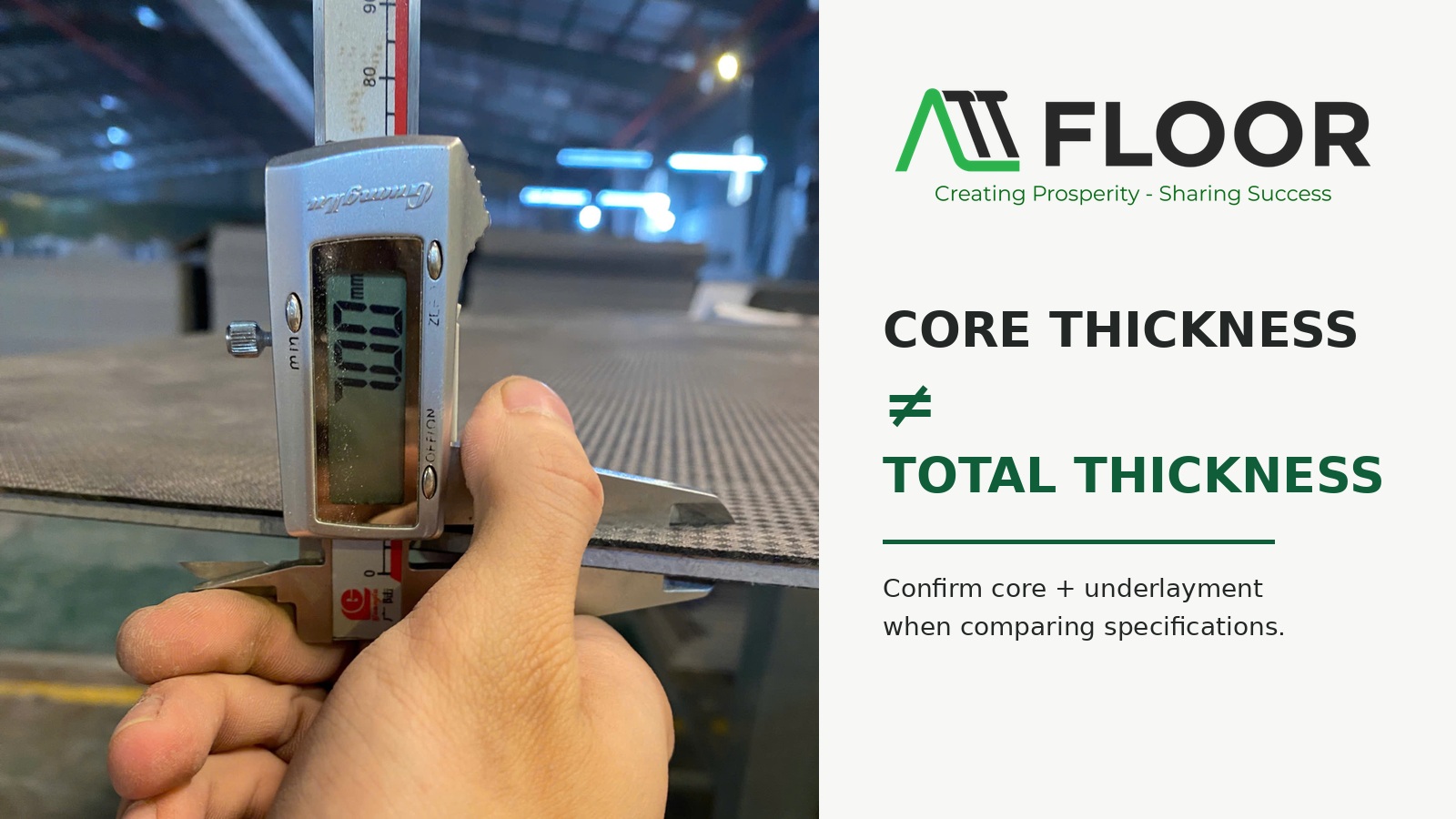
SPC flooring thickness inspection
4. How to Choose the Wear Layer
The wear layer protects the decorative surface during use and is another major specification buyers compare.
Higher wear-layer specifications generally involve additional material and cost.
But again, the objective should not simply be:
“Give me the highest wear layer.”
Instead, consider the intended application and the requirements of the target market.
A useful sourcing principle is:
Do not maximize specifications. Optimize them.
If additional specification creates meaningful value for the target customer, it may be justified.
If it only increases cost without improving the product's commercial position, it deserves reconsideration.

SPC flooring abrasion resistance test
5. Choose the Attached Underlayment
Attached underlayment such as IXPE is common in SPC flooring.
When requesting a quotation, specify it separately from the SPC core.
Instead of:
5 mm SPC with pad
use:
4.0 mm SPC Core + 1.0 mm IXPE
This avoids confusion and allows accurate comparison between suppliers.
Just like core thickness, however, increasing pad thickness should have a reason.
The complete construction should support the target application, market position and cost structure.
6. Consider Size, Surface and Appearance Together
Technical specifications are only one part of the product.
The end customer experiences the flooring visually.
That makes plank size, wood decor, surface texture, gloss and groove appearance important product-development decisions.
6.1. Plank Dimensions
Different plank dimensions can change:
- Installed appearance
- Product positioning
- Packaging
- Production configuration
- Container loading
Choose dimensions that make sense for the market rather than selecting them in isolation.
6.2. Surface Appearance
When evaluating samples, look at the complete visual combination:
Color + Wood Pattern + Texture + Gloss + Groove
A technically strong product can still be difficult to sell if its appearance does not match customer expectations.
Technical specifications define the product. Appearance helps sell it.

SPC flooring wood design and surface texture
7. Check the Click-Lock System
SPC flooring does not function as individual planks. It functions as an assembled flooring system.
For this reason, buyers should not evaluate only one sample board.
Assemble several planks and check:
- Connection
- Alignment
- Edge condition
- Visible gaps
- Overall finished appearance
Click-system licensing may also be relevant depending on the product and destination market.
ATT Floor uses a licensed Unilin click-lock system for its SPC flooring.

SPC flooring click lock assembly test
8. Remember That Specification Affects Landed Cost
This is where product development becomes more commercial.
Changing an SPC specification does not affect only the factory price.
For example, increasing thickness can affect:
Material Consumption
↓
Product Weight
↓
Container Loading Quantity
↓
Freight Cost per Sq Ft
↓
Landed Cost
Therefore, product development and logistics should not be treated as completely separate decisions.
A specification may look attractive on paper but become difficult to sell if the final landed cost pushes the product beyond its intended market position.
For importers, one of the most useful questions is:
What specification gives us the right product at a workable landed cost?

SPC flooring specification and landed cost
How to Import SPC Flooring from Vietnam: A Practical Guide for International Buyers
9. Build a Product Range, Not One “Perfect” Product
For distributors, a useful strategy is to avoid making one specification serve every customer.
Instead, consider a simple product matrix:
| Position | Specification Strategy | Main Objective |
|---|---|---|
| Value | Cost-efficient construction | Competitive entry price |
| Core Range | Balanced specification | Main sales volume |
| Upgraded | Higher specification where justified | Higher product positioning |
The exact thickness, wear layer and pad should depend on the actual market.
The important idea is that each specification should have a commercial purpose.
This gives buyers more flexibility than trying to create one supposedly “perfect” SPC floor.
10. The Best Specification Is the One That Fits the Market
Consider two products.
Product A has higher technical numbers, but its landed cost makes it difficult to sell competitively.
Product B has a carefully selected specification that meets the intended requirements while reaching the target price position.
The second approach illustrates an important principle in product development:
Performance + Appearance + Cost + Logistics + Market Acceptance
must work together.
This is why the best SPC specification is not necessarily the one with the biggest numbers.
The objective is not maximum specification. It is maximum product-market fit.
11. Developing SPC Flooring With ATT Floor
ATT Floor manufactures SPC rigid core flooring in Vietnam for importers, distributors, wholesalers and private-label customers.
There are two practical ways to start a product discussion with us.
11.1. Send Your Existing Specification
If you already import SPC flooring, send us your current:
- Core thickness
- Wear layer
- IXPE requirement
- Dimensions
- Surface requirement
- Colors
- Packaging
- Estimated quantity
We can evaluate the specification against our manufacturing capability and prepare a comparable quotation.
11.2. Send Your Target Market
If you are developing a new product, tell us:
Target Market → Customer Segment → Product Position → Target Cost
From there, we can discuss suitable SPC flooring configurations based on your requirements.
This approach is often more useful than simply asking:
“What is your cheapest SPC flooring?”
Because the objective is not only to obtain a low factory price.
The objective is to develop a product that can sell, compete and generate repeat orders.

ATT Floor SPC flooring manufacturer Vietnam
12. Request a Specification & Factory-Direct Quote
If you are sourcing SPC flooring from Vietnam, send ATT Floor either:
Your current specification
or
Your target product requirements.
Useful information includes:
Core Thickness | Wear Layer | IXPE | Size | Surface | Quantity | Destination
We can then review the requirement and prepare a factory-direct quotation for comparison.
REQUEST A QUOTE | REQUEST SAMPLES
13. Frequently Asked Questions
13.1. What SPC flooring thickness should I choose?
There is no universal thickness for every market. Consider the application, product positioning, complete construction, cost and target customer.
13.2. Is a higher wear layer always better?
A higher wear layer represents a different product specification and generally affects cost. The appropriate specification should be based on the intended application and market requirements.
13.3. Is SPC core thickness the same as total thickness?
Not necessarily. Total thickness may include both the SPC core and attached underlayment. Confirm both separately when requesting quotations.
13.4. What information should I send for an SPC flooring quotation?
Provide your core thickness, wear layer, pad, plank size, surface requirement, quantity and destination where available.
13.5. Does ATT Floor support OEM and private label?
Yes. ATT Floor supports OEM and private-label SPC flooring, subject to the agreed product, quantity, packaging and commercial requirements.
Conclusion
Choosing an SPC flooring specification should not begin with:
“How thick can we make it?”
or:
“What is the highest wear layer available?”
It should begin with:
Who is the customer, what does the market need, and what price position must the product achieve?
Once those questions are answered, thickness, wear layer, IXPE, size, surface and click system become much easier to define.
For importers and distributors, that is the difference between simply buying a flooring specification and developing a product for a market.
-------------------------------------------------------------------------------------------------------------------
You can refer to How to Import SPC Flooring from Vietnam: A Practical Guide for International Buyers
Manufacturing Factory 1: Km7, Ha Nam Ward, Ninh Binh Province, Vietnam
Manufacturing Factory 2: Kim Binh Cluster, Ha Nam Ward, Ninh Binh Province, Vietnam
Manufacturing Factory 3: Lot CN-1.7, Le Ho Industrial Cluster, Le Ho Ward, Ninh Binh
Phone/WsA: +84 915961582
Email: tom@attfloors.com


How to Choose SPC Flooring Specifications for Your Market
Friday,
18/09/2026


SPC Flooring Factory in Vietnam: Inside the Manufacturing Process
Thursday,
03/09/2026
